
Nerve damage is one of the most common injuries in rope. Developing a deep understanding of major nerve locations reduces risk when tying and helps you respond quickly when a problem arises. Knowing the science behind nerves is only the first step; you can explore how each person is different and how the body evolves over time.
General Information About Nerves
Nerves run everywhere in the body and transport information between the brain, the spine and the rest of the body in both directions with electrical impulses. Nerves are like a cable, made of several axons (fibres) protected by a sheet of fat and protein. Nerve cells can be up to 1m (3 feet) long. They consume a high level of energy, so it is common for nerves to run along blood vessels.
Sensory nerves bring the information from the body to the brain, while the motor nerves bring the information in the opposite direction. Mixed nerves play both roles. For example, when you prick your finger on a needle, a sensory nerve sends this information to the brain and spine, which then sends an order to contract the arm muscle to pull your finger away via a motor nerve. Some neural pathways form an arc where an impulse is given without reaching the brain; this is a reflex. Other nerves function without being conscious about them, such as the nerves that operate our gastrointestinal system.
Nerves Injuries
Damaging a nerve is the most common of the high-impact risks of rope bondage. An injured sensory nerve can create a numb patch, while motor nerve damage can cause weakness or an inability to move a limb. The consequences will happen distally to the location of the injury; for example, if you injure a nerve at the elbow, the portion of the nerve in the upper arm will continue to work fine, and the symptoms will manifest in the forearm and hand.
Nerve injuries in rope bondage are usually caused by compression. It can be directly from external pressure (rope or other objects like leaning on something or rope pressing on clothing), or indirectly from the pressure of the body itself. For example, clenched muscles or swelling tissue or expanding by trapped blood building pressure in a limb, can also press on a nerve. Nerves are also vulnerable to shearing forces; think of twisting spaghetti.
Nerve damage happens outside of rope, walking with crutches, physical exercise, broken bone, weight loss, sleeping in a bad position, repetitive movement or posture can all cause nerve injuries like numb patches, weakness in a limb or chronic pain like carpal tunnel syndrome. It can be from a single impact, but is more often cumulative after repeated and/or extended pressure.
Nerve compression may come with warning signs such as tingling, numbness, pain, zapping, burning, but often there are no signs at all. It is tricky to identify the signs as they can be very different from one person to another, from one nerve to another, or easily confused with other symptoms like those from restricted blood circulation. Sensory fibres are generally most vulnerable, while motor nerves are more sturdy. Tingling and numbness might show up earlier than motor weakness, but they might also all show up at once. The symptoms might also show up after the tie, especially when inflammation and swelling is involved.
In case of injury, no pressure should be added on the location of the injury; avoid massages and give the nerve the time to rest. Nerves take a long amount of time to heal, and once injured, they might stay vulnerable indefinitely. Permanent damage is possible, but usually, as long as the cell body of the neuron is intact, there is a high likelihood that the nerve will heal. Healing may also be impacted by other conditions like diabetes or thyroid disease.
- Step 1 – Remove the source of the problem – Go smoothly; changing position under compression may add shearing force. Time is key; the longer the compression, the higher the impact. Ask for help if possible.
- Step 2 – Reduce the swelling – If swelling is part of the issue, ice and anti-inflammatory medicine are possible options. Remember that the injury location is “upstream” from the area with symptoms. Some people with pre-existing conditions should avoid anti-inflammatories. Ice used to be the top recommendation, but the evidence on its effectiveness is limited.
- Step 3 – Good nutrition to help your body heal – B12 vitamin, magnesium, electrolyte, etc.
- Step 4 – Check with your physician – If things don’t return to normal quickly, consult a medical professional for more precise guidance.
The science around what to do in case of nerve injury is constantly evolving; keep your eye peeled for different sources of information.
Upper Body Nerves
The arms are a particularly vulnerable part of the body to study, and this is where most ties start. Understanding nerve pathways and their function is the most important step in mitigating the risk of nerve injury.
Upper Limb Nerves and Functions
It all starts at the spine at the neck level; the nerves come out from vertebrae C3-T1. Then they merge in the shoulder/armpit area in a structure called the brachial plexus. The brachial plexus contains three trunks that will split and merge and split again into the different nerves of the upper limb.
The shoulder is a complex articulation that can move in different directions. The axillary nerve (deltoid, triceps, teres minor) is responsible for our ability to lift the arm. There are known cases where high pressure on the top of the shoulder or internal body mechanical pressure on this nerve caused a weakness in lifting the arm. The long thoracic nerve runs along the chest and pulls the shoulder blade down. When injured, it causes a syndrome called “winged scapula” where the shoulder blade becomes protuberant.
The supraclavicular nerve may be injured with high pressure to the collarbone in specific positions like the demon pose (tengu), causing a numb patch on the top of the shoulder.
Also in the upper arm, the musculocutaneous nerve (bicep) and the suprascapular nerve (rotator cuff) are not known to be injured in bondage but can suffer from entrapment should there be inflammation in the shoulder region.
From there, three main nerves control the rest of the arm: radial, ulnar and median. Any or all three can be injured at the armpit level where it comes out of the brachial plexus. There are several reports of injuries to these nerves at the armpit, most often caused by a cinch pressing on the inside of the arm.
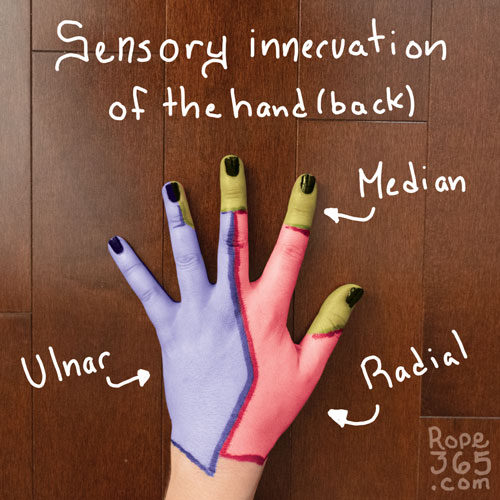
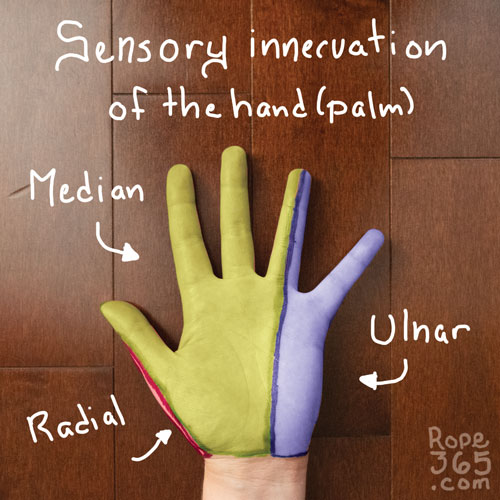
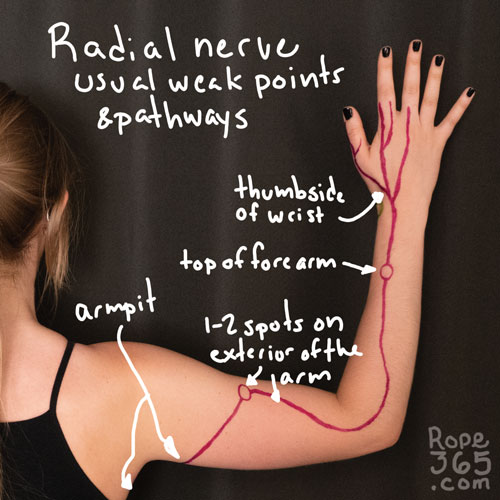
The radial nerve wraps around the upper arm and innervates the forearms that will allow it to open the hand; it then continues as a sensory branch to the top of the hand on the thumb side.
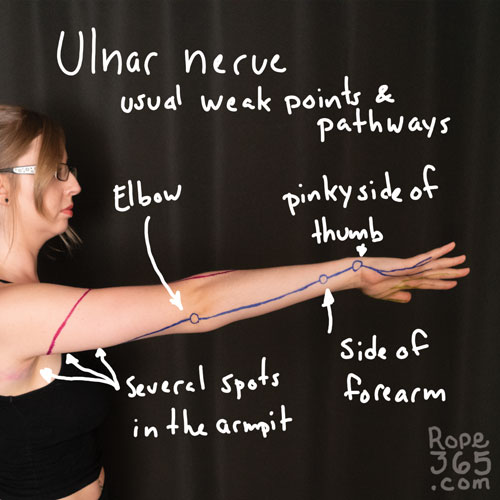
The ulnar nerve runs along the elbow to the spot commonly known as “funny bone”, continues its path to the pinky side of the wrist and allows the pinky side of the hand to close and move sideways (abduction) and detect sensation on the side of the hand as well.
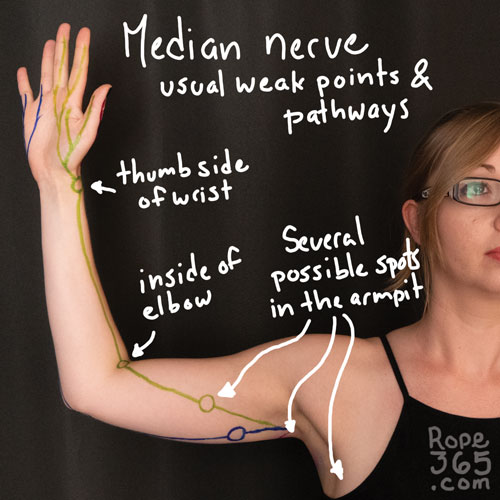
The median nerve runs on the inside of the arm and inside the elbow, then on the thumb side of the wrist. It activates the thumb side of the hand to close and move sideways (abduction).
Overview of the Nerve Functions
| Nerves | Motor functions | Sensitive functions | Notes |
|---|---|---|---|
| Spine – cervical C3-T1 | Whole arm and shoulder | Whole arm | If you suspect a problem at the spine, consult a medical professional and check for pre-existing conditions (ex: slipped disk). Protect the neck from sudden movement and bad position. |
| Axillary | Lift arm (abduction) | Lower part of the deltoid muscle | Can be injured by intense pressure on the shoulder or by mechanical internal pressure. |
| Long thoracic | Pull the scapula down | N/A | Injury to the long thoracic nerve will create a syndrome called winged scapula. |
| Suprasclavicular | N/A | Top of shoulder | Can be injured with intense pressure near the collarbone in specific body positions. |
| Suprascapular | Arm rotation, abduction | Shoulder joints (no skin sensations) | Unlikely to be injured in bondage |
| Musculocutaneous | Flex upper arm (bicep) | Forearm thumb side | Unlikely to be injured in bondage |
| Radial | Wrist extension, Open hands | Top of hand thumb side | Damage to the upper portion can cause “wrist drop”, damage to the lower on the arms at the wrist or hand will only affect sensation. |
| Ulnar | Hand flex and abduction pinky side | Hand pinky side | Damage at the wrist limits side-to-side finger movement; damage at the elbow also limits flexion of these fingers. |
| Median | Hand flex and abduction thumb side | Inside of hand thumb side | Damage at the wrist limits the ability to make a fist. |
Upper Limb Nerve Location and Drawing Pathways
Even if we generally have the same nerves, the precise path they take changes from person to person. By combining anatomy knowledge and body awareness, you can better understand your own pathways through stretches and palpation.
To find exactly where the nerves run for you and your partner, you can apply gentle pressure along the arm and monitor tingles and weakness in the hand to find the spots where the nerves run more superficially. It is usually easier to find the nerve if we engage the muscle around it. Avoid this technique on someone who recently had a nerve injury as pressure may aggravate an existing problem. This procedure is not without risk, avoid sudden pressure and keep it short.
Here are a couple of spots to look for when palpating to find nerve location. It’s very likely that some spots will not work, and you might find new spots for you that aren’t documented. Finding unusual placements is the best part of this experiment. As you get more body awareness, it gets easier to find the nerve location.
Brachial plexus
- On the chest at the top of the armpit
- On the arm where the skin of the armpit folds
Radial
- Exterior on the arm at the insertion of the triceps, around the base of the deltoid. Usually, one or two spots can be found. Engaging the triceps can help you feel the nerve.
- Center top of the forearm, usually at a third of the forearm toward the hand.
- Topside of the wrist, thumb side.
Ulnar
- Look for spots on the back of the triceps.
- Elbow exterior, bend the elbow and look for the funny bone. Usually very exposed on the very tip of the elbow and may continue higher up.
- Forearm, pinky side (more difficult to find)
- Wrist, pinky side toward the palm
Median
- Bicep on the inside of the arm.
- Inside of the elbow.
- Wrist, thumb side toward the palm.
Upper Limb Nerve Glides
Nerve glides are techniques to position the body so that a nerve is at its full length. As you move into the position, you will progressively feel the targeted nerve pathway and the region of the body related to those nerves. It is also known as nerve flossing and nerve stretching, but it is not clear if this actually moves or stretches the nerves.
These are sometimes recommended by doctors to help nerve scar tissue heal and reduce entrapment, but don’t overdo them, as they can cause irritation to the nerves as well. We list the steps, and it’s very likely you won’t need to reach the last one to feel the nerve; no need to go further once you feel it. Keep it light, progressive, and be gentle with your body, especially if you have previously injured those nerves. As you gain more body awareness, it gets easier to feel the nerve pathways.
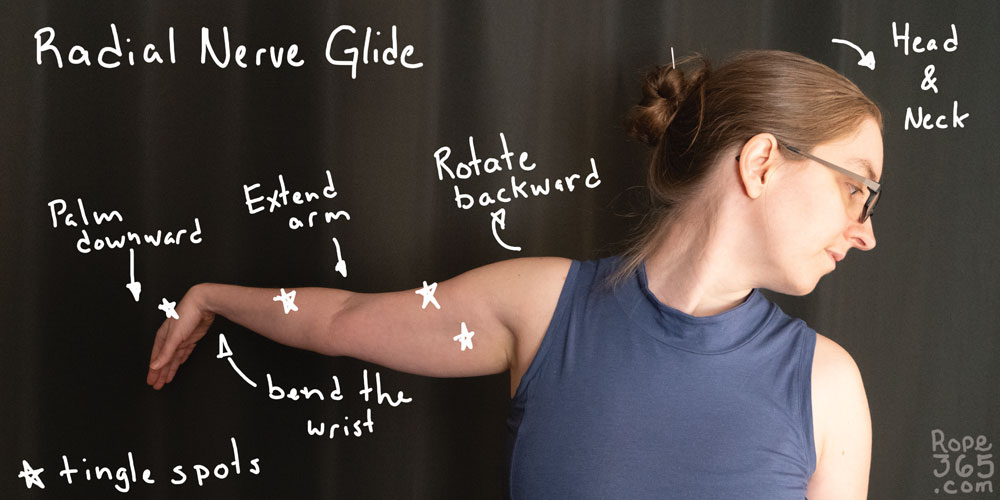
Radial
- Extend the arm on the side, palm facing down.
- Bend the wrist down.
- Bend the neck and the head to the opposite side.
- Rotate the arm a bit more to the back.
- Feel the nerve along the arm and the top of the hand, thumb side.
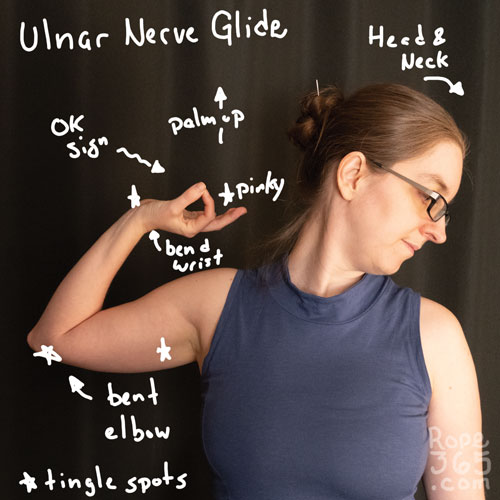
Ulnar
- Make an ok sign with the fingers.
- Bend the elbow with the palm to the sky.
- Rotate the hand to get the thumb toward the sky.
- Bend the neck and head to the opposite side.
- Feel the nerve in the elbow and the pinky as it gets stretched.
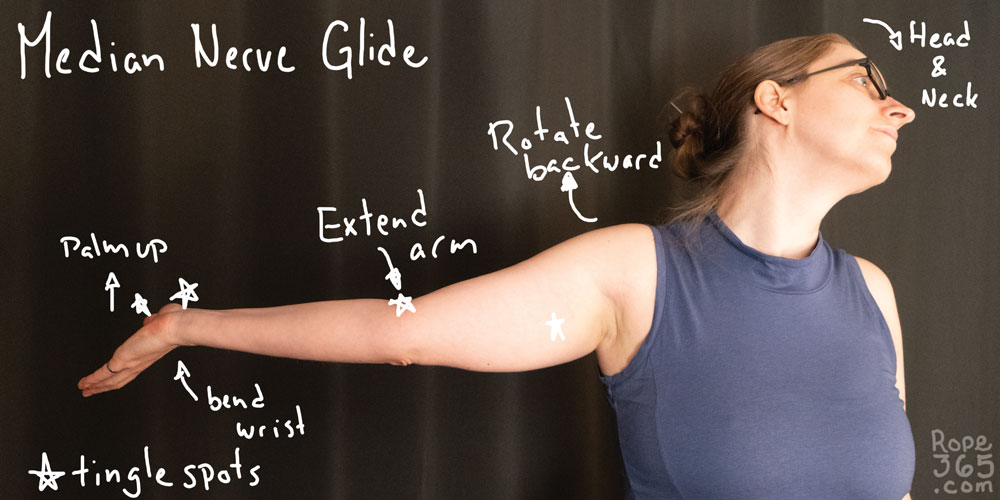
Median
- Arm straight to the side, palm to the sky.
- Extend the wrist, pointing the fingers to the floor.
- Bend the neck, the head to the opposite side.
- Feel the nerve at the thumb and along the whole arm.
There are more positions like these; check the reference section for more ideas.
Hand Check
During and after the tie, it is good practice to check that all motor functions are still present. This can be done by extending and squeezing with the hands. Discuss with your partner beforehand which hand-check technique you prefer, who should be responsible for checking, and when.
To monitor sensory function, scratching the top of the thumb is a common self-check for radial problems. To quickly check for motor function, quickly opening and closing hands (also known as flashing).
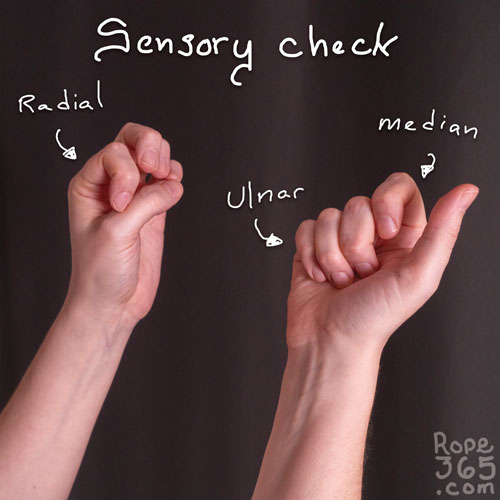
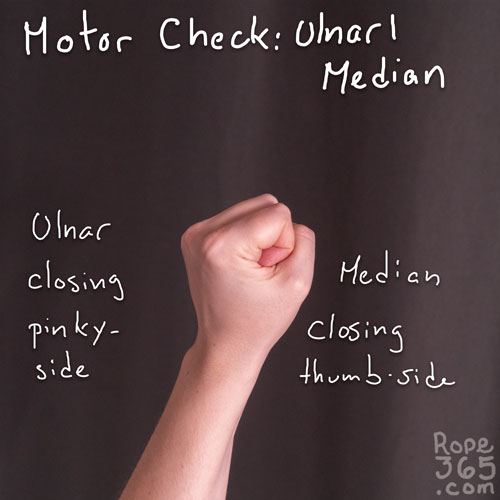
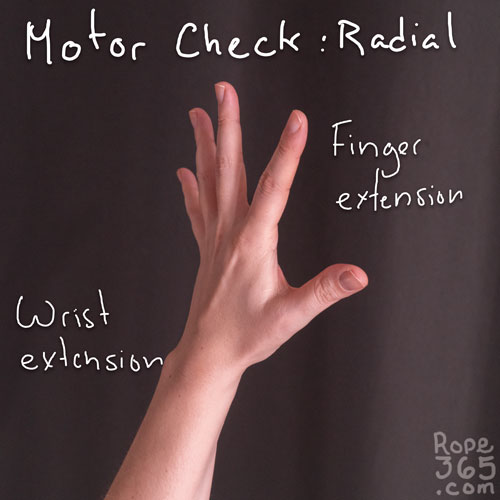
Another technique is to do hand positions that require all the nerves to function properly to execute. You should try these positions beforehand as a baseline, as not everyone has the same flexibility. Here are some ideas to try:
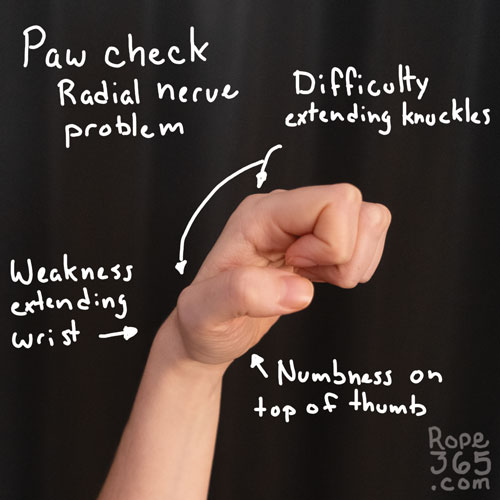
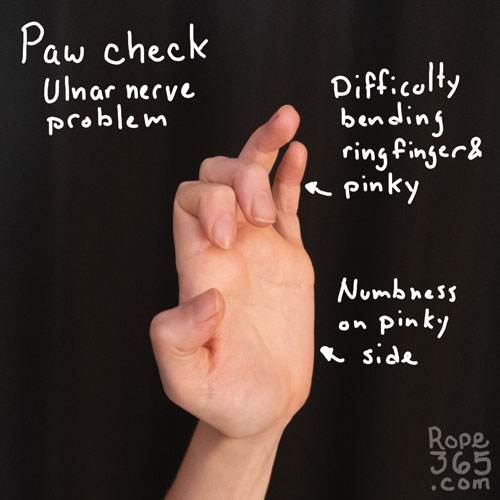
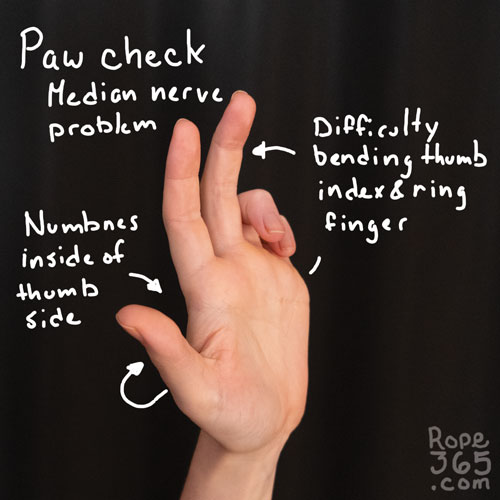
The Bear Paw
Extension at the wrist and major knuckle will allow to monitor the radial nerve while closing the other phalanges monitor the ulnar and median.
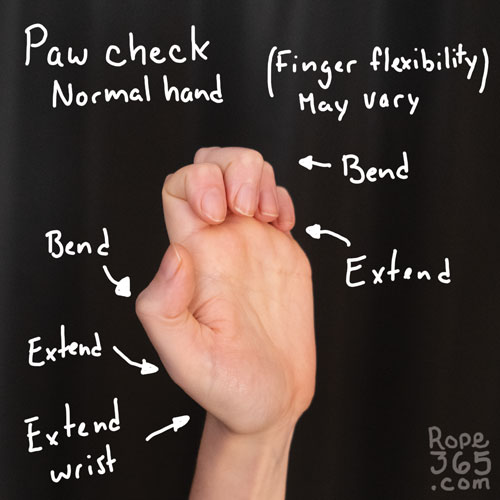
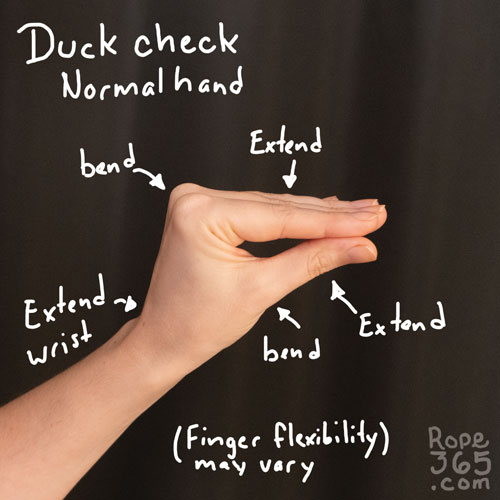
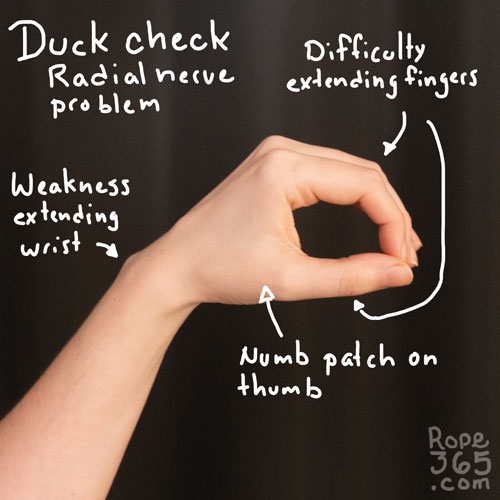
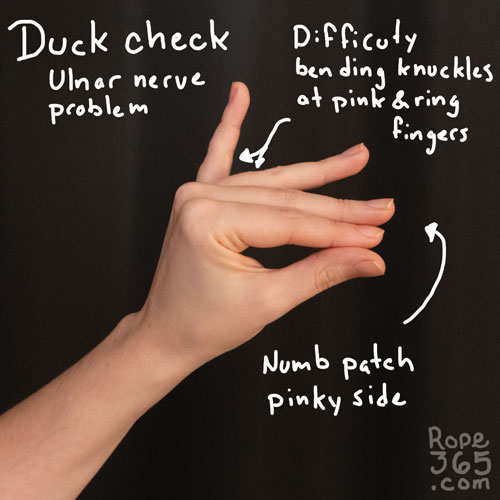
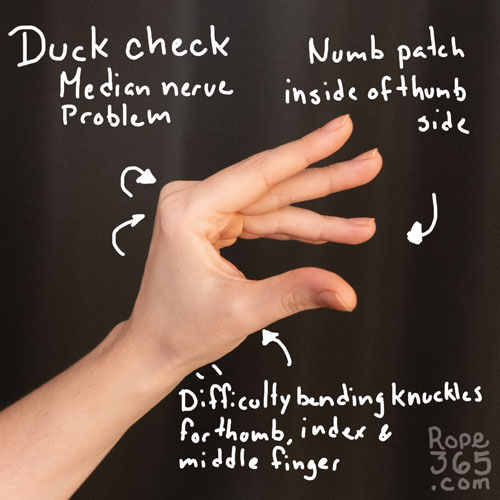
The Duck
Closing the major knuckles allows us to monitor the ulnar and median while tension at the wrist and extension of other phalanges monitor the radial nerve.
Common Upper Body Ties and Nerve Placements
Different ties will rotate the arm in various positions, exposing nerves in different ways. Combining knowledge of nerve placement with the possibilities of each tie allows for maximum mitigation.
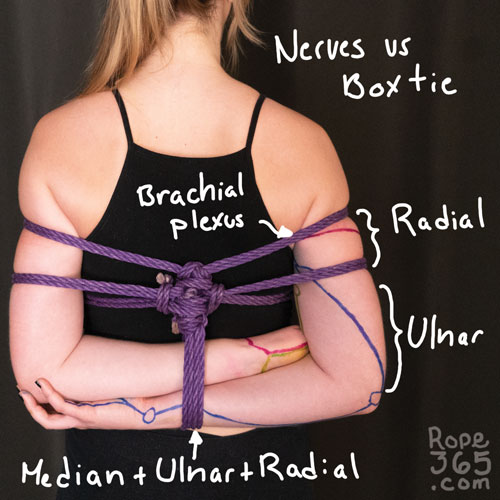
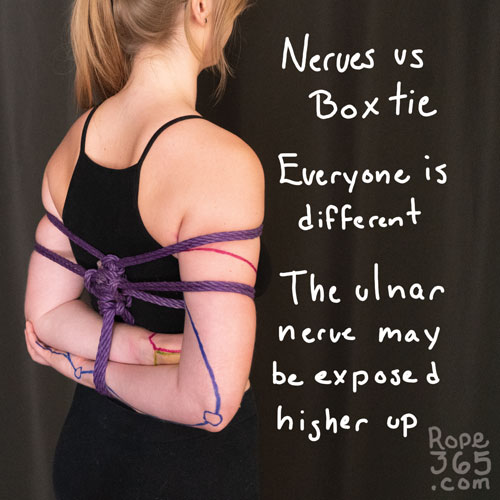
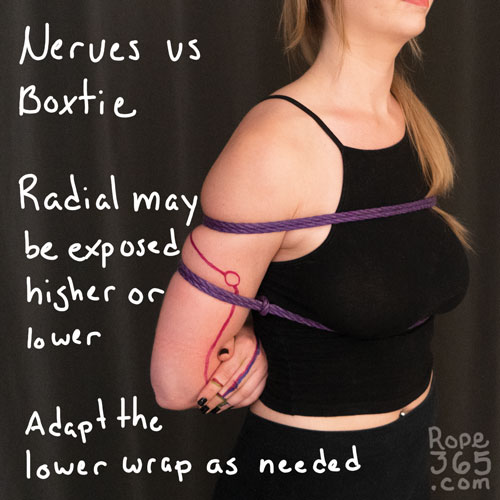
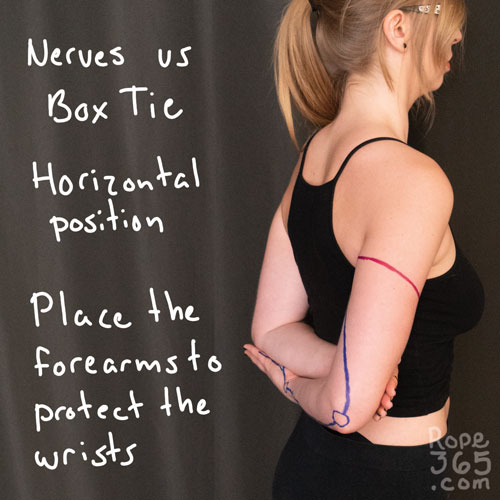
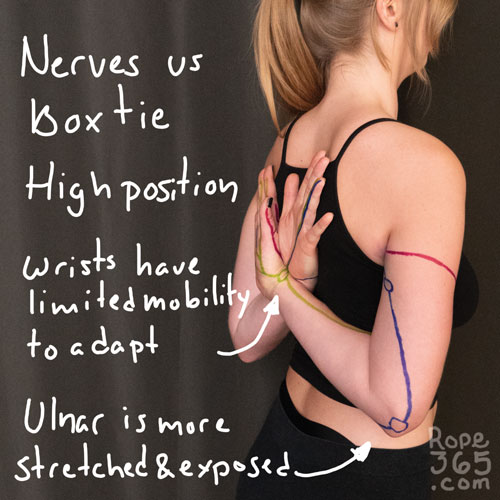
Box Ties
The box tie is high risk because it can injure several nerves in several locations. The initial single column tie may hit nerves at the wrist. Ideal wrap placement depends on how high the ulnar is vulnerable at the elbow and where the radial is exposed on the side. The cinches may also be a source of incidents. Depending on whether the wrists are high, low, or in between, the position might stretch the ulnar, and it may be more or less exposed depending on how the elbow bones protect it.

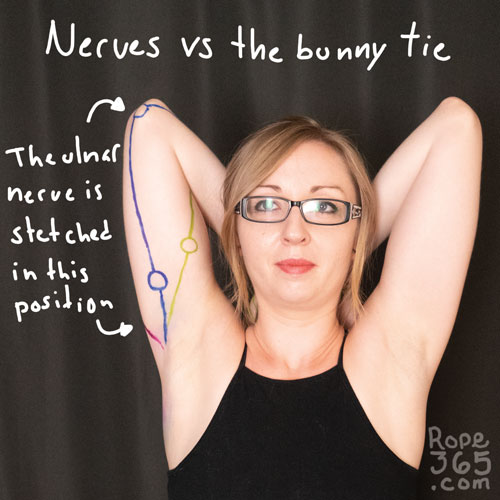
Bunny Ear – Upper Arm of the Riffle Tie
This position will stretch the ulnar nerve at the elbow; pulling the skin up may provide some relief. Avoid pressure on the ulnar and median nerves near the armpit.

Strappado
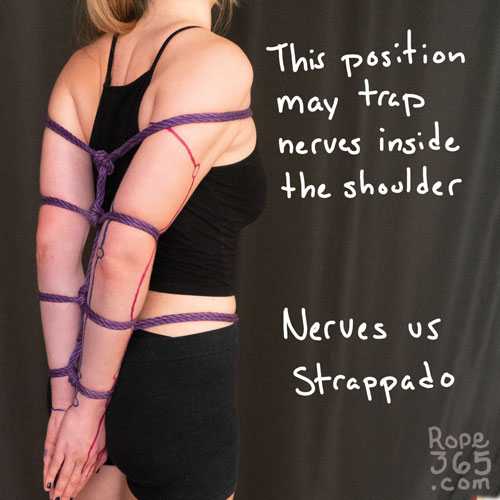
Most ties with the arms parallel in the back put wraps in all along the arms, so the wrists and elbows are common problematic locations for wraps. The biggest problem with strappado is unfortunately more difficult to see, as we bring the elbows closer in the back, internal body mechanical pressure can occur on the inside of the shoulder. A good strategy is to roll the elbow in when bringing the arms back to prevent bulk in the armpit. A light twist on the bicep may also help to free some of the tension. For most people, this position will be very difficult to hold for an extended period of time, and the arms will need to be brought to the front to solve the issues.

Lower Body Nerves
Knowledge of lower body nerve pathways is also important to mitigate injuries. The hips and legs are strongly built to handle the pressure of day-to-day movement with large muscles and bones. Compared with the upper limb, the nerves are deeper in the body, so the risks in bondage are different. Most of the superficial nerves are sensory branches, and the larger muscles have a higher tendency to cause entrapment.
Lower Body Nerves Functions and Common Rope Injuries
Rope-related nerve injuries in the lower body most often involve damage to sensory nerves, leading to numb patches of skin that can take a long time to heal. Motor nerves might still be injured, as there are a few known cases of “foot drop” caused by rope play. The vast majority of these injuries often involve a high amount of pressure that is often present when doing suspension but also when doing high compression on the body in floorwork. Compared with the upper body, the nerves in the legs are buried deeper in the body under larger muscles; on one part, it means they are more protected, on the other, it makes them harder to locate to prevent injuries.
At the tip of the coccyx, you’ll find the coccygeal plexus, the origin of the coccyx’s skin’s sensory nerves. This spot might be sensitive when adding a crotch rope and highly varies from person to person. Those who had a broken tailbone in the past might have extra pain when pressing on that spot.
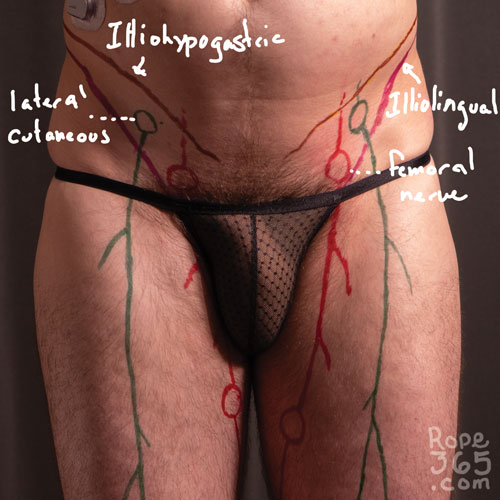
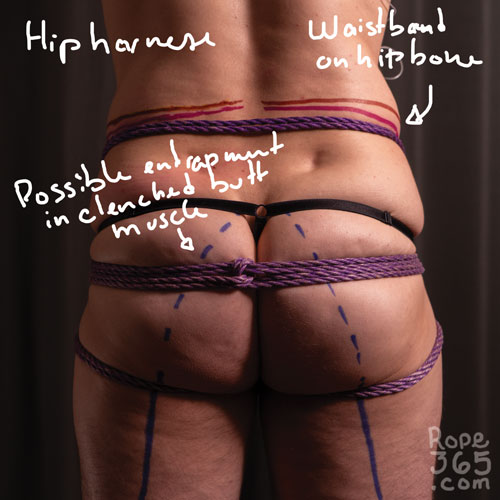
In the hip, the iliohypogastric and the ilioinguinal nerves circle around the waist toward the front. They have motor functions for the abdominal muscles with several sensory branches. These nerves can be compressed by a hip line digging very deep above the hip bone, causing numbness in the groin area.
The cluneal nerve is a sensory nerve that innervates the upper part of the butt skin and may be injured by entrapment within the butt muscles. This can happen in rope play if someone clenches their buttocks muscles really hard for an extended period of time.
The obturator nerves are exposed in the groin area, on the inside of the leg. Compression of this nerve may cause a numb patch lower down in the upper inside of the leg.
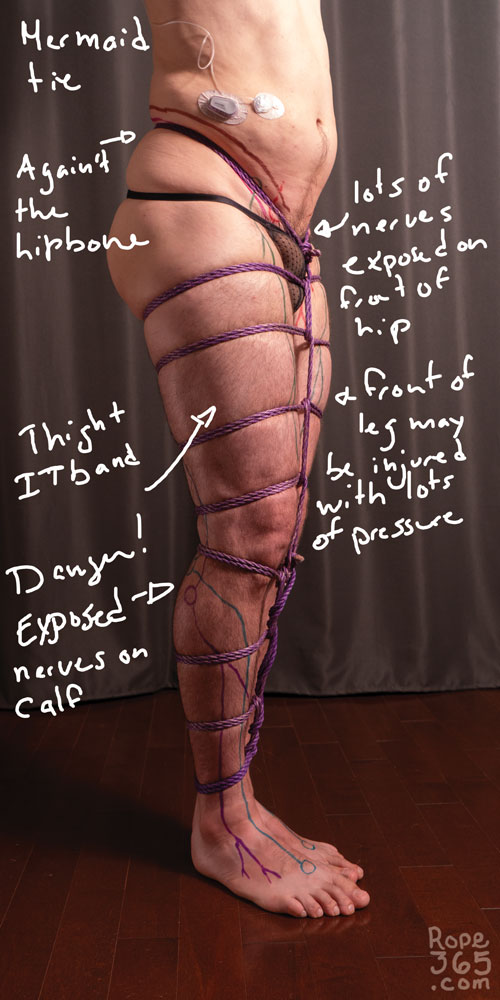
The lateral cutaneous nerve is a sensory nerve that runs along the front of the hip and side of the leg. Its most common injury is with hip harnesses that press on the inside of the hipbone. This will create a numb patch downward from the location of the injury.
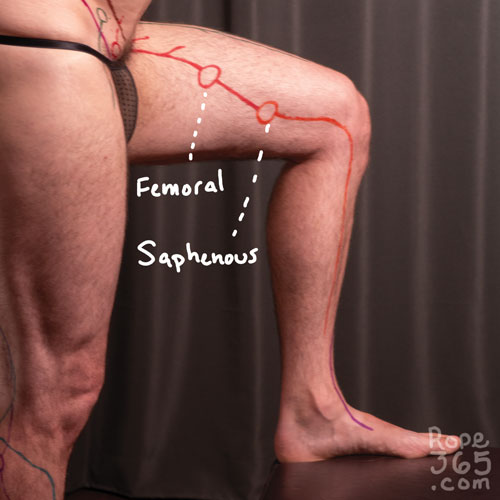
The femoral nerve is responsible for flexing the hip joint and extending the knee. It is also the sensory nerve that innervates the front of the thigh. It has a few vulnerable spots, at the hip and on the inside of the legs. There are known injuries in bondage of high compression or entrapment in the thigh muscles causing numbness downward from the location of the injury.
The saphenous nerve is a branch of the femoral that is only sensory and innervates the inside of the calves. It is especially vulnerable behind the calf close to the knee.
The sciatic nerve is the longest nerve of the body; the part of the nerve from the spine to the knee is rarely known to be injured in bondage. That said, sciatica is a common sports injury. If you are aware of sciatic sensitivity, take the time to understand how movement can trigger nerve issues to avoid issues during rope play.
In the lower leg, the sciatic nerve branches out as the peroneal/fibular nerves. The deep peroneal’s motor function is to lift the foot, and its sensory branch innervates a small spot between the big and second toe. It has a weak spot on the calf behind the knee. Injury higher up on the calf might cause foot drop, which is probably the lower body nerve injury with the highest consequences, along with a numb patch on the top of the foot. Injuries lower on the leg will create sensory problems only.
Another important branch of the sciatic nerve is the superficial peroneal/fibular nerve. This sensory nerve innervates the front and outside of the lower leg and the top of the foot. It is most vulnerable behind the top of the body prominence of the fibula on the calf close to the knee.
[Coming soon. Diagram of sensory innervation of the lower body]
There are, of course, many other nerves and branches of these nerves that are interesting to study. Medical resources are full of interesting details on the nerves, their function and how to heal them. This is just an overview.
Overview of the Lower Body Nerve Functions
| Nerves | Motor functions | Sensitive functions | Notes |
|---|---|---|---|
| Coccygeal plexus | N/A | Coccyx skin | Nerve cluster at the tip of the coccyx is sensitive; can be hit with crotch rope |
| Iliohypogastric | Internal and transverse abdominal muscles | Lateral gluteal and hypogastric (lower belly) region | Vulnerable with high pressure on the waist around the hip bone |
| Ilioinguinal | Internal oblique and transversus abdominis muscles | Superior medial thigh and part of the scrotum/penis root or part of the clitoris/labia | Vulnerable with high pressure on the waist around the hip bone |
| Cluneal | N/A | Upper part of buttocks | Vulnerable to entrapment in the buttocks muscle |
| Obturator | Adduction of the lower limb | Interior of the thigh, slightly above the knee | Vulnerable in the groin area. |
| Lateral cutaneous | N/A | Front and outside of the thigh | Vulnerable just inside of the front body of the hip. Common hip harness injury. |
| Femoral | Flex the hip joint and extend the knee | Front and middle of the thigh.
Indirectly inside of the lower leg. | Runs wide of the femoral artery (where you can feel your pulse in the groin). Vulnerable at the hip and along the exterior of the leg. |
| Saphenous (via femoral) | N/A | Inside of the lower leg | Final branch of the femoral nerve. Vulnerable behind the thigh close to the knee |
| Sciatic | Muscles of the posterior thigh and the hamstring portion of the adductor magnus.
Indirectly innervates all the muscles of the lower leg and foot. | No direct sensitive functions.
Indirectly the exterior of the calf, the heel and a large portion of the foot. | Sciatica is a common sports injury. The nerve is well protected from rope pressure but can be injured with movement, especially if there is a pre-existing condition. |
| Deep peroneal/fibural (via sciatic) | Lift the foot | Area between the first 2 toes | Damage behind the knee can cause foot drop. Also vulnerable on the top of the foot, which only causes numbness between the toes. |
| Superficial peroneal/fibular (via sciatic) | N/A | Front and outside of the lower leg and top of the foot | Most vulnerable just behind the top of the bony prominence of the fibula. |
Lower Limb Nerve Location and Drawing Pathways
Finding the nerves in the hips and legs can be challenging as they can be covered by large muscles. Finding them by palpation may require a bit more pressure than in the upper body. These nerves are still fragile, so add pressure progressively and avoid shocks when trying to find the location. Engaging the muscles around the nerves usually makes them easier to find, but sometimes this adds a layer of protection. Play with the tension in the body to find what works for you at each location.
As with the upper body, nerve pathways are unique to each person. Here are some spots to try palpation to see if you can find the nerves.
- Lateral cutaneous – Front of the hip, right inside the hip bone
- Femoral
- Front of the hip, lower toward the pubis
- Along the inside of the leg, usually more vulnerable in the midpoint of the thigh
- Obturator – groin area
- Saphenous – Inside of the thigh, toward the knee
- Deep peroneal/fibular
- Top of the calf, the knee joint
- Mid front top of the foot
- Superficial peroneal/fibular – Top of the calf, toward the outside
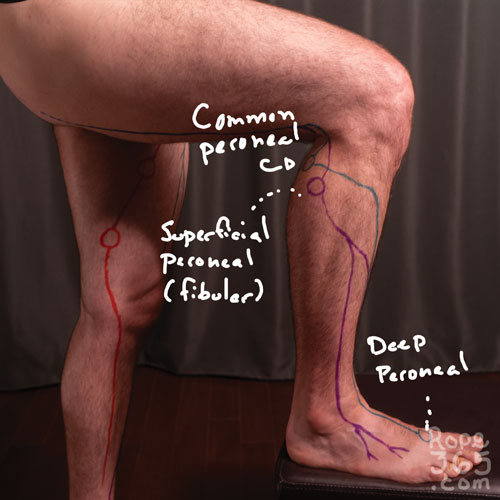
Cutaneous innervation of the legs
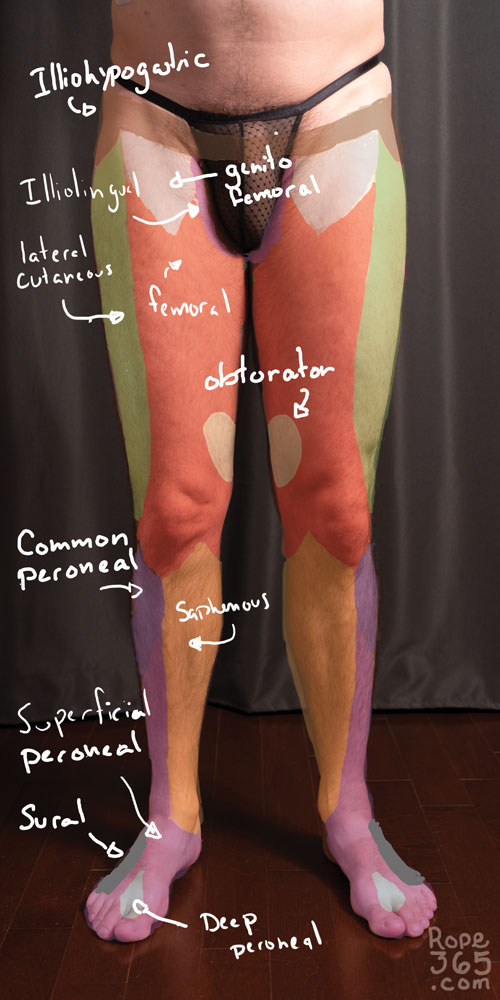
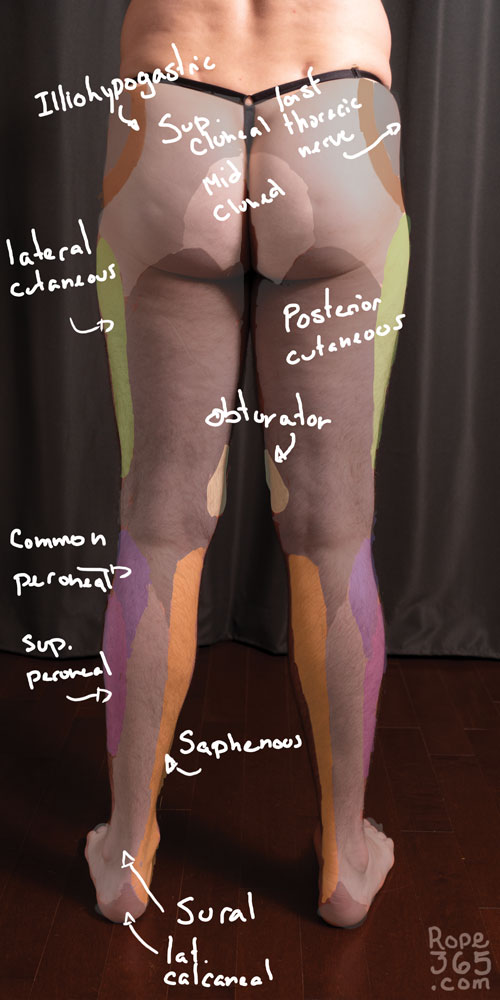
Lower Body Nerve Glides
Coming soon. See references below.
Lower Body Nerve Check
Making sure all nerves are in good working order in the lower body is very different from the upper limbs. It is much more difficult for the person being tied to self-check.
On the motor side, the most likely problem is foot drop, so it’s good to lift the foot from time to time. This also helps circulation by contracting the calf muscles. If we suspect some weakness, we can try pushing against a light pressure on the top of the foot and comparing both sides.
Monitoring sensation loss is much more subtle. One strategy is to touch the leg skin on the different nerve zones. This check can take the form of pleasant caresses. It might be difficult to feel numbness when we are overloaded with other sensations, so it’s good to do it periodically during the tie and as we remove the rope to feel any sign of sensory change.
Should you feel signs of nerve injury, avoid sudden movement that can worsen the injury. Loosen the rope in the affected region if possible, then remove the rope completely and avoid any pressure until healing is complete. Consult a medical professional if the movement or sensation doesn’t resume quickly. Check back on Day 50 for more detail on how to deal with nerve injuries.
Common Ties and Nerve Placements
Different types of lower body structure have different risks. Structures at the hips should have their top wrap again the hip bone, so that they avoid the nerves in the waist and other organs. The middle of the hips depends on the direction of pressure. Harnesses that pull from the front often will pull the pressure away from the nerves in the front. Harnesses that pull from the back should avoid wraps at the hips to prevent injuries, or keep them lower toward the leg. Avoid diagonal lines that may put pressure on the lateral cutaneous nerves. The cuffs around the legs should be kept looser to prevent pressure at the joint; placement preference will vary from person to person. Some prefer it as high as possible; others prefer a small gap. Too low might end up on the femoral nerve.
Calf harnesses and mermaid ties carry the biggest risk as compression on the back the calf near the knee may result in a foot drop injury. Find the sensitive spots; place the wraps above or below those spots. Depending on the direction of pressure, make sure the wrap can’t slide into the nerves during play.
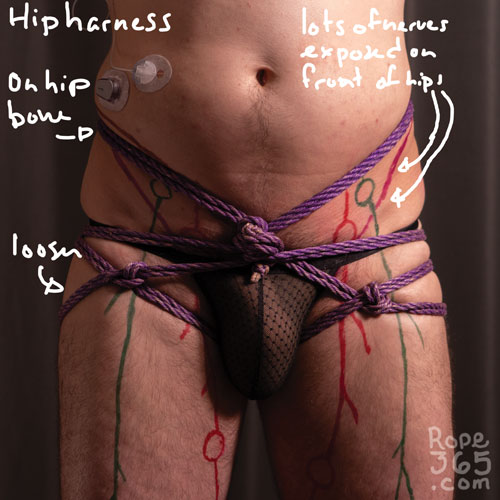
Practice Time!
Get some marker pens, find the nerves and draw their path on the body. Use different colours for different nerves.
Exploration ideas:
- Check out different medical resources to get a better understanding of the nerve anatomy.
- Try different nerve glides with the arms, legs and neck and note the different sensations you experience.
- Palpate the body to identify the nerve pathway and draw the location as you find spots where the nerves run more superficially.
- Try palpating with the limbs in different positions.
- Are both sides identical?
- Try different ties such as a box tie, strappado, bunny ears, hip harness and a mermaid tie, and observe which nerves can be hit.
- Try drawing other parts of the body such as muscles and bones
- Try different hand checks in different positions to see what feels best. How many hand positions engaging the three main nerves can you make?
Inspirations and Resources
- How to check for Nerve Damage during a Rope Scene by Shibari Study
- Nerve damage flyer by Anatomie Studio
- Lower body nerves by p_e.ropes
- Nutrition to support recovery after nerve compression (TL;DR: Go fish!) by ruminating
- Acute Radial Compressive Neuropathy: The Most Common Injury Induced by Japanese Rope Bondage
- Nerve damage prevention (available in several languages) by Antoine Savalski and Elise Depont
- Nerves and Circulation by Rope Study
- Anatomy for Rope Bondage by IPCookieMonster
- Nerve injury: Treatment & Management (Rope Bondage) by Lightwriter
- Takate Kote Wrap Positioning Survey Results by Topologist
- On My Nerves: Moving away from recommending ice for bondage-related nerve injuries by Shayblondie
- Mobilization of the Plexus Brachialis Nerve Branch by Sin (Kinbaku Today)
- Nerve palpation by Zac Cupples
- On My Nerves: Moving away from recommending ice for bondage-related nerve injuries by Shayblondie
- Incident reports
- Shibari and Radial Nerve Damage- an experience and a warning by grudney
- Minor radial nerve compression during floorwork by Baol
- Winged scapula probably due to compression of the long thoracic nerve by atamagaii
- Patch of numb skin at base of thumb after double column on wrists by FoxOfBangkok
- Common fibular nerve compression: a numb shin, past injuries, and a tingly ankle two months later by AresOrange
- Nerve glide videos by Doctor Jo
- Nerve glides by hand.therapy.group
- Femoral Nerve Nerve Flossing by Dr. Abelson
- Femoral nerve glide floss by Rehab My Patient Variation 1 Variation 2 Variation 3 Variation 4
- Peroneal nerve glide floss by Rehab My Patient Variation 1 Variation 2 Variation 3 Variation 4
- Sciatic nerve glide floss Variation 1 Variation 2 Variation 3
- Medical videos by Dr. Nabil Ebraheim (check the whole channel for more anatomy and medical knowledge)
- Nerve Injury, Positions Of The Hand
- Brachial Plexus Branches & Nerves
- Radial Nerve Anatomy
- Radial Nerve Injury, Where Is The Injury
- Anatomy Of The Ulnar Nerve
- Ulnar Claw hand
- Anatomy Of The Median Nerve
- Median nerve compression
- Femoral Nerve Anatomy
- Anatomy Lateral Femoral Cutaneous Nerve Of Thigh
- Posterior Cutaneous Nerve Of The Thigh
- Anatomy Of The Thigh
- Foot Drop, Peroneal Nerve Injury
- Anatomy Of L5 Nerve Root Muscle Innervation
- Anatomy/Surgery images for those interested in bondage safety
- Radial nerve compression possibly caused by muscles by MoonlightShadow
- Entrapment: matching nerves and muscles by MoonlightShadow
- Main nerves of the lower extremity by Kenhub
- The surgical anatomy of the lateral femoral cutaneous nerve in the inguinal region: a meta-analysis by Springer Nature
Or return to Anatomy for more options
Credit: Thanks to MissDoctor for her knowledge and support – M: Miss Soffia R/P: Ebi McKnotty
2 responses to “Day 50: Nerves”
-
This is amazingly thorough. Even though I’ve tried to scour every corner of the internet for resources and information on rope safety/risks there is still info here I’d never encountered before. I would appreciate seeing something on flexibility and irritating joints/arthritis but I’m not sure how you’d quantify it or do it well.
Thanks so much for this Ebi
-
So glad you enjoyed it. There was a lot of research that went into building this page. And still adding stuff to it once in a while when new information surface. I’m adding information about flexibility in the mobility pages. If we find someone knowledgable about irritating joints/arthritis, I would love to host of link to that information. Not something I’m knowledgable about myself. Thanks for your feedback!
-


Leave a Reply