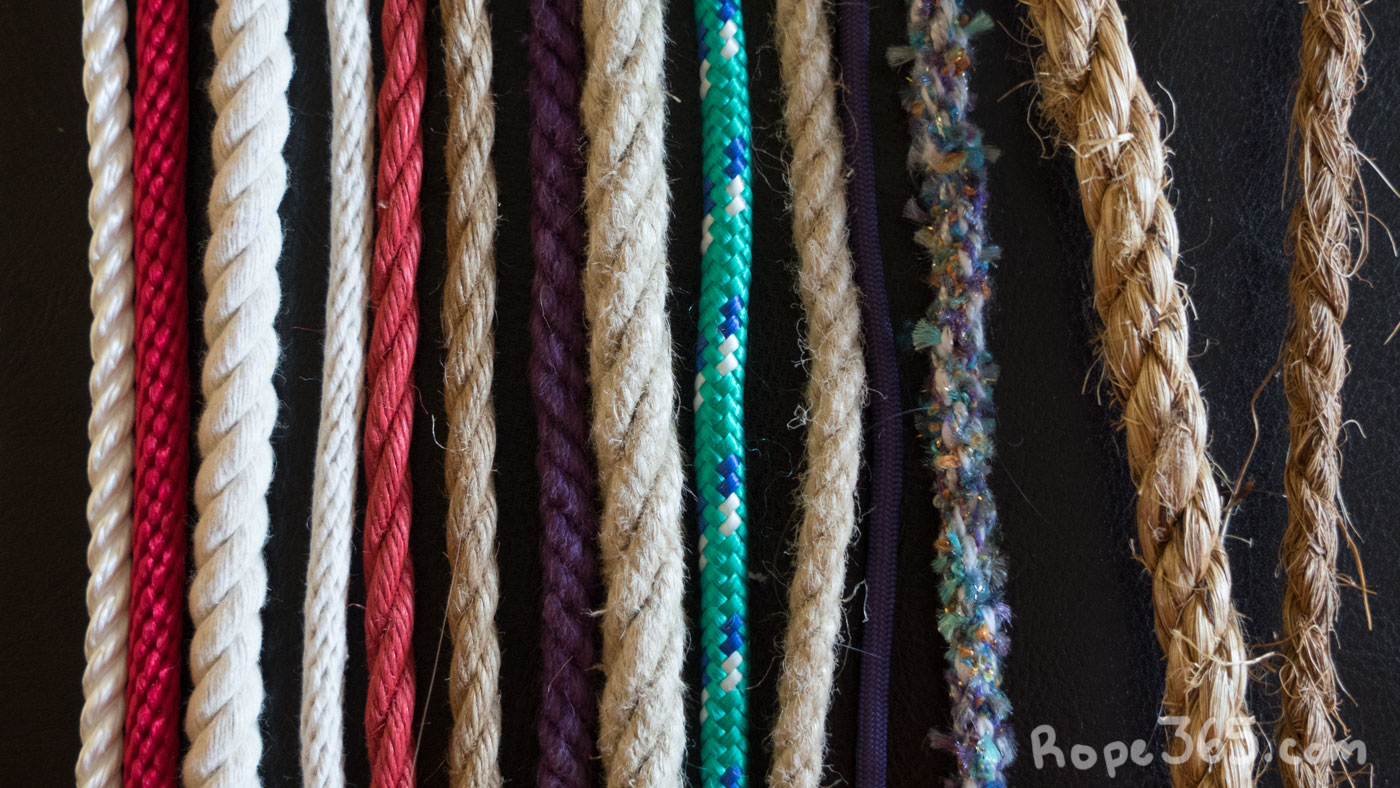
Many different materials can be used to make rope. Plants like cotton, jute, or hemp are common rope materials, as are synthetic fibres like nylon, polyester, or MFP. There are also other organic materials like silk or bamboo that are less common but have interesting properties. Some materials will handle tying knots better than others; some can be unsafe to use for bondage as they contain chemicals that are bad for the skin; others will provide unique sensations. Expanding our understanding of the diversity of rope materials and what makes each of them special will help you find the perfect rope for the occasion.
Characteristics of Rope Materials
To better understand the different types of rope material, let’s look at the characteristics that influence tying.
Stretch – A stretchy rope makes tension harder to handle with precision and can create a tourniquet effect when used to restrict the body. In general, it is considered better for the rope to be stiff as it allows for more precision in ties. Some will prefer something more stretchy to add some bounce and prevent shock in movement. Super stretchy rope can create a painful slapping effect when pulled, but will also cut blood circulation very fast.
Burn speed – How fast can you drag the rope on the skin without burning it? The higher the speed, the better, as it allows you to tie faster without causing injuries and lowers the risk of accidentally causing a rope burn. Unlike regular rope marks that just disappear over time, rope burns are painful and can leave wounds that can scar and infect if not treated.
Weight – The lighter the rope, the faster it can be handled. The difference in speed becomes more noticeable as your handling gets better. Some people prefer to have more weight and enjoy how it presses against the body and how it falls on the floor.
Grip – The capacity of rope to hold in place when wrapping around something. This will influence the types of knots and friction you use. With slippery rope, you might need to add additional knots to hold things in place, or use a full lock instead of just wrapping things around with friction. It is easier and faster to create a stable structure with ropes that have a good grip.
Maintenance – Some ropes can be tossed in the washing machine and come back sparkling clean. This is the case with most synthetic fibers. Other ropes, especially the ones vulnerable to water, can be damaged in the cleaning process if not dried properly. This means the rope will require more maintenance effort and might be impossible to sanitize. Organic ropes tend to require more maintenance, but also often have antimicrobial capacities.
Abrasive vs smooth surface – Some prefer more abrasive ropes and others the opposite. Oiling, waxing and other preparation can help make the rope texture smoother for organic rope. Smoother rope usually has a higher tendency to create rope burn and have a lower grip.
Lifespan – No rope lasts forever, but some materials age better than others. Organic materials will improve early in their journey, like leather, becoming more supple with use. Then they will progressively degrade over time depending on use. Synthetic materials tend to stay the same over time, degrade much more slowly, and may last indefinitely under lighter use.
Strength – The strength of the rope is usually measured by the amount of loads that can be put on it before it breaks. This characteristic has less impact if you aren’t doing suspension or climbing. Even weaker ropes like jute are used in suspension, but the line system needs to have more redundancy to mitigate the risks. Industrial ropes such as nylon and cotton are likely to have official tensile strength on the package, but most handmade rope won’t, as there is too much variation in the making process to make a precise assessment. Stronger rope tends to have longer lifespan.
Price – Hand-made and hand-processed rope will be more expensive but will generally yield better characteristics and be smoother, even and more pliable. Lower-priced rope tends to be low quality, but some high-quality rope can come at a lower price if you do some of the processing yourself. Depending on your location, some rope may get expensive when adding importation costs as well.
Reaction in water – Some rope will shrink when wet. This means that the person in the rope will get compressed and knots will become very hard to untie. Drool or wet hair are enough to create small problems if you are not prepared for it. Rope materials like jute are most vulnerable to water and may become permanently deformed when wet. Most synthetic ropes won’t be very affected by water; some may sink, some may float, most will become more abrasive when wet.
Allergies – Some people are allergic to specific materials or to some of the oils used in rope preparation. This is more common with rope made out of grass and other organic material. If you already have allergies, it is good practice to get a sample first to find out if a rope is safe for you before spending a lot of money on a kit. Most reputable rope makers will adapt their process to accommodate allergies when they can.
Comparing Popular Materials
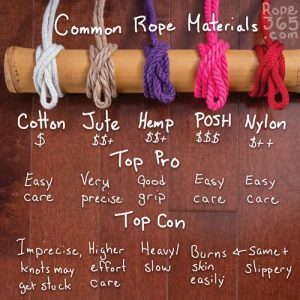
Cotton, jute, hemp, polyester and nylon are some of the most popular types of rope in bondage. Let’s compare these based on different characteristics. This is an approximate evaluation, as ropes differ depending on source and construction.
Cotton – A soft rope that can also be easily found at the hardware store. This is a very good starting rope as it is quite average on most characteristics, easy to wash and cheap to buy. Cotton is very soft, but may compact into knots that are difficult to untie. It is also stretchy, so it is difficult to control tension with this type of rope.
Jute – The traditional Japanese style rope, light and fast to use, holds friction firmly and looks terrific in photography. It has a stiffer texture and makes some cracking noise that some will love or hate. Jute can be quite abrasive when brand new and will become smoother with use. As it finds few uses outside of the bondage world, jute is harder to find outside of specialized rope makers, which increases the price. It is a high-maintenance rope as the twists need to be maintained. Water shrinks the fibres so it needs to be stretched to dry when washing the rope.
Hemp – Sturdier and heavier than jute, with a similar tooth and “natural” look, hemp is another popular rope material. It is a bit more stretchy than jute, losing some precision. People will usually love or hate its unique grassy smell. Hemp is seldom sold outside of bondage rope maker shops, but can sometimes be found in eco-friendly shops that sell other hemp products. Hemp needs some light maintenance and is easy to wash.
POSH – This polyester rope has become quite popular in bondage as its twisted construction gives an organic look with all the advantages of synthetic rope: strong, long-lasting, and easy to wash. It is also less stretchy and more grippy than most synthetic rope, but not as much as jute. It’s biggest downside is the burn speed, which is much lower.
Nylon/MFP – These two synthetic types of rope share most characteristics. They usually have a shiny, slick appearance and are a bit slippery to work with. They can be easily found at the hardware store for a low price, but higher quality products can be found from specialized vendors. There is a huge variety of ropes made out of these materials, so don’t stop your search at the first one you try. This type of rope tends to be quite popular in styles with lots of knots and weaving, and also in dynamic ties where there is a lot of bouncy movement.
| Characteristics | Cotton | Jute | Hemp | POSH | Nylon |
|---|---|---|---|---|---|
| Precision | — | ++ | + | + | – |
| Speed | – | ++ | + | – | — |
| Grip | – | ++ | + | + | — |
| Maintenance | ++ | — | – | ++ | ++ |
| Lifespan | – | – | + | ++ | ++ |
| Strength | — | – | + | ++ | +/++ |
| Price | $ | $$+ | $$+ | $$$ | $++ |
- Precision: A lower stretch in a rope allows for more precision in tension.
- Speed: weight and how the rope can burn the skin change the speed of tying you can reach.
- Grip: how well the rope can do frictions, slippery ropes require extra turns.
- Maintenance: how easy the rope is to wash and care for.
- Lifespan: how durable the rope is in the long run.
- Strength: The tensile strength of a rope when loaded, if you ever intend to suspend with it. A low-strength rope will require more redundancy.
- Price: how expensive the rope is. Lower-priced rope tends to be low quality, but some high-quality rope can come at a lower price if you do the processing yourself.
Exotic Ropes
There are too many types of rope to list them all, but some have special characteristics that make them a nice addition to the toy bag.
Scratchy Ropes
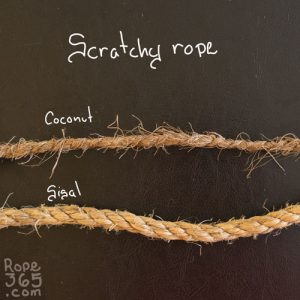
Sadists and masochists alike may enjoy abrasive ropes for sensation play such as manila, sisal, coconut/coir, rice or palm frond. Beware, the hands of the sadist will also suffer! Manila and sisal are easily found in the hardware store, but they will often be full of chemicals that make them unsafe to use on skin. Coconut is sometimes used in the brewing process and can be found for cheap under the name coir rope. In this case, the rope is food-grade and safe to use on the skin. Rice rope is also interesting as it was the type of rope used in lots of early Japanese photography and has a particular aesthetic. After some use, these ropes will become smoother and progressively lose their evil edge.
Bamboo and Silk
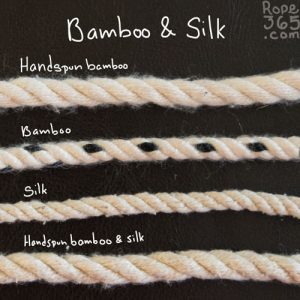
Bamboo rope is usually very soft and has a little bit of elasticity. It is common to see it mixed with silk for a really soft experience. The anti-microbial characteristics of bamboo rope make it interesting for ties that are in contact with genitals and fluids. A lot of rope sold under “silk” is actually MFP or nylon; check the labels to make sure what you are buying.
Strong Rope
Some rope is mostly sought out for their higher tensile strength for use in suspension or climbing. These rope materials also have various qualities that make them interesting outside of suspension.
Hempex – Strong like nylon, with the look of hemp and a somewhat abrasive texture. Hempex floats in water and doesn’t shrink when wet, which makes it a very interesting rope for water bondage.
POSH – Made from polyester, POSH mimics the look of natural rope with a high tensile strength, a less abrasive texture than Hempex but a bit less grip and flexibility.
Paracord – A thin, lightweight and very strong rope made of nylon that comes in a variety of colours. As you can guess from its name, it is made for parachutes, but is also popular for microbondage and decorative ties. Military shops usually carry a selection of colours for a low price.
Dyneema – Marketed as stronger than steel, this rope is sometimes used in dynamic suspension, but rarely directly on the skin as it is
Reinforced rope – Some rope makers will add a strand of a stronger material in their rope to increase their tensile strength. This process creates a rope that looks very natural but can affect rope abrasiveness, burn speed and stability.
Animal Hair
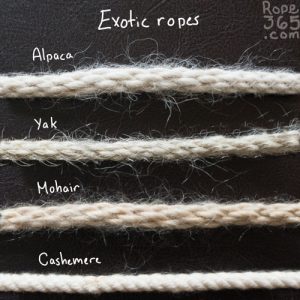
Rope made out of animal hair such as cashmere, mohair, alpaca or yak are less common but have interesting characteristics. The price of these exotic ropes is generally much higher, but each provides a unique texture that is both soft and scratchy. These are usually loosely woven and can be quite stretchy.
Elastic Ropes
Climbing rope or bungee cord can allow some fun predicaments or dynamics. It is not recommended to use elastic ropes directly on the skin as they may create a tourniquet effect and can behave unpredictably. They can be interesting to attach to two parts of the body, add dangling objects, or to tie someone to a fixed point with a reward out of range. They also make excellent slapping tools.
Electroconductive rope
Rope can be woven with other materials to allow electric conductivity. It is interesting to combine this kind of rope with other toys like a violet wand to expand the type of play.
Practice Time!
Make a trip to the hardware store, your local rope practice space or the vendor area of a rope conference. Gather as many types of rope as you can, try them out and explore the differences. Many online stores can also send you samples for a small fee.
Pick a tie you enjoy, try to do it with as many different types of rope as you can.
Exploration ideas
- How does it feel on the fingers?
- How does it feel being tied in?
- Compare the same friction with different types of rope
- Does it stretch? How does stretching affect tension when tying
- Do you like the smell?
- What happens when the rope is wet? Does it float?
Inspirations and Resources
- Rope Shopping by Rope365
- Rope Properties and Care References Youtube playlist by Rope365
- Rope Material Selection by Topologist
- Choosing the Right Rope for YOU by BryanT-Corn’
- Bondage Rope: What Kind Of Rope Is Best For Bondage? By Pete Riggs
- Tying Shibari with “Slippery Rope” Nylon Etc. by kni
- Synthetic fibers used in rope manufacture by -Steven-
- Choosing the fibre by Shadow
- Choosing Jute rope for bondage by WykD Dave
- Rope Allergies by WykD Dave
- The Only Jute Rope You Should Use for Suspension by Topologist
- Rope Types Chart by jaxinslacks
Or return to The Rope for more options.
Credit: R/P Ebi McKnotty
5 responses to “Day 43: Material”
-
Real knowledge, well presented without prejudice.
Table is excellent.-
Thank you. I’ve been trying to collect information from people with various preferences, but it’s hard when I love jute so much. I wish I had that table when I got started.
-
-
I also like another material on your website called “kni’s Rope Materials Primer”. I didn’t know about POSH type, want to try. In China it is easy to find cheap hemp ropes on the market, but most of them smell so awful, hard to get rid of that odour. Also it is a bit annoying to have rope fibers everywhere in the room. I found that braided cotton rope is the best choice for me due to its softness and absence of any smell. After several attempts I got one that does not stretch too much.
I also tried twisted synthetic rope, but it was so hard that leaves rope marks after a short time. Braided synthetic, cotton and hemp are much softer.-
Thank you for sharing. Finding the right rope for you often involves trying a lot of things.
-
-
A useful rope to try is flax, often sold as linenhemp. I have a friend who is allergic to both hemp and jute. Flax works for them.


Leave a Reply