Different medical conditions may affect your preparation, choice of ties and safety protocols. Sometimes a condition is known and you can work with medical professionals to prepare in advance. With chronic illness, the best experts are often the people who lives with them. Other conditions may surprise you during a tie, such as vasovagal response that leads to fainting under certain stimuli. By broadening your horizons on different conditions and their impact on rope play, you will be better equipped to mitigate risks and be ready for the worst.
Taking a First Aid Training
Education and training is the most impactful step you can take. First aid classes usually cover basic interventions protocol, identifying the most common medical conditions and how to deal with different scenarios. Some tips:
- The baseline protocol is usually to secure the space, call for help (911 or equivalent), and then check for the ABC: airways, breathing, circulation.
- You should not move someone who fell with impact and/or is at risk of spinal injury unless there is a more imminent threat (ex: the room is on fire).
- The recovery position is great way to position to prevent further harm. Especially if the person is unconscious or at risk of falling.
- Stay calm. Controlled action will yield better results. Plus tripping while running for help isn’t going to help anyone.
Coming soon – picture of recovery position.
First aid training can help you react in case of emergency, and you should refer to medical professionals for further assistance.
Common Medical Conditions and their Impact on Rope Play
The following are some of the most common conditions I have encountered and how they affected play. I have yet to see an illness that completely prevents someone from rope play, but everyone has limits, preferences and sometimes these are driven by our medical conditions.
Asthma
Discuss ahead what are the possible triggers and how to proceed depending on the severity of the Asthma. Dust from the rope, breath restricting position and other environmental particularities may impact the likelyhood of an asthma attack. Make sure to keep the medication close by and to know how to operate it as different pump have different mechanisms.
I have personally witness an attack from being in a tight strappado. The sustained opening of the chest was restricting the breathing. The dusty room was probably not helping either. A friend administered the medication as the rigger was releasing the rope with control.
Diabetes
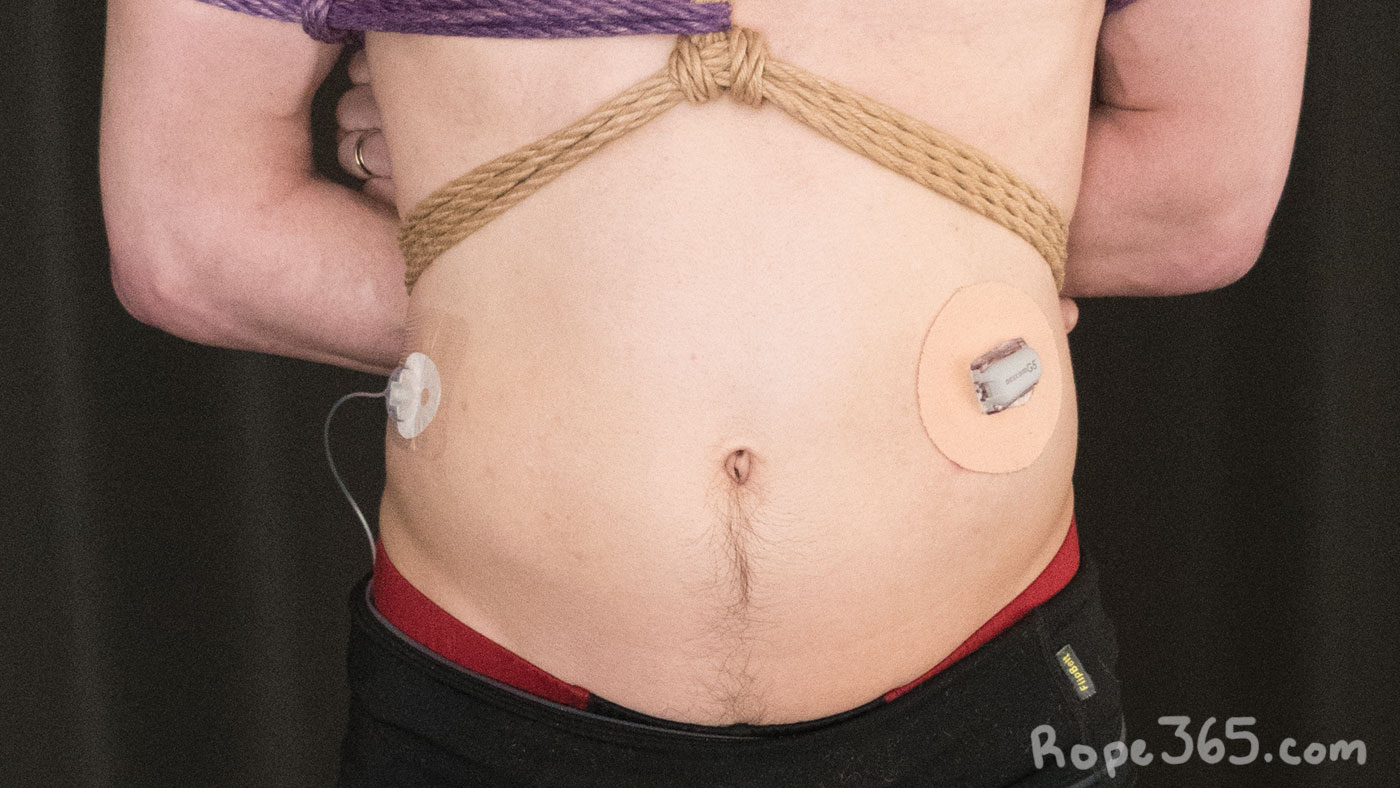
The two types of diabetes have drastically different causes, and this condition varies greatly from person to person. Discuss ahead what low blood sugar and high blood sugar look like for them and how they prefer to handle it. Keep some sugar and a glucometer nearby just in case. For diabetics in rope with medical devices attached to them such as an insulin pump and/or CGM (continuous glucose monitor), you may have to adapt rope placement to avoid putting pressure on them. Note that over time, diabetics may have less sensation in extremities; monitor accordingly. Diabetics may also heal more slowly from other injuries such as nerve damage.
Ehlers-Danlos Syndrome (EDS)
Being hypermobile allows to create more extreme poses in rope, but these can quickly turn into injuries. Often people with EDS won’t feel pain from their joints being stretched until it’s too late, potentially leading to long-term injuries. This will also aggravate over time with repetition. People with EDS may also have stretchy skin, which changes how the body bruises and marks.
To prevent injuries, avoid passive stretching and instead engage the muscles in all stretches to protect the joints. This is actually a good tip to prevent stretching injuries for everyone, but particularly important for people with EDS. For people tying with hypermobile fingers, using finger splints can help prevent the joints from overextending when pulling the rope.
There are many types of EDS and the different symptoms are on a spectrum. Just like other conditions, be curious about the condition in general and how it affects the person specifically. Are some joints already injured and do some tend to pop more easily?
Pregnancy
As a new life is being created, most people will reduce their risk level, especially avoiding ties with risk of falling. The hormones from pregnancy have a big impact on the body; in particular, ligaments will get looser, and ties that pull on joints, such as the strappado, should be handled with care.
Raynaud syndrome
Coming soon
Vasovagal Response
Every human is at risk of fainting in rope, which is why our safety protocols should always include it. This should include a safe way to guide the body to the floor, and tools to get them out; from there, move the person to recovery position and get medical assistance if the person doesn’t recover consciousness immediately. If the person tying is the one fainting, having someone to support (spotter) and/or a voice-activated device to call for help can be life-saving.
Standing still and hanging in vertical positions are infamous for causing fainting. Keeping the legs active helps reduce the risk by maintaining good blood circulation. There are a few common signs that people may experience right before fainting that can help you anticipate it and potentially prevent it, such as: shivers, sweats, black dots in vision, ear ringing, dizziness, etc.
People with chronic vasovagal response will learn with time what triggers them, signs that it is about to happen and can then avoid/limit these situations. Sometimes it’s a position, a pressure point, etc. Ask your medical professional to get a better understanding of the condition and develop adaptations that work for the specifics of the person.
Other conditions
There are more medical conditions than we can possibly list here, but some of the mitigation patterns are the same. Be curious about medical conditions and ask a medical professional to understand the limits of movement, pressure to the body and triggers to be avoided. Are there any medications or medical devices related to this condition, and how/when they should be used? If you are not comfortable talking about bondage, you can use similar activities like aerial yoga or martial arts as a starting point in the discussion. Generally, the safety protocols of a specific medical condition are not specific to rope.
If you are experienced with a specific condition and would like to share your knowledge, you can send a short text to info@rope365.com so we can add it to this page to help others with a similar condition.
Practice Time!
Take the time to reflect on the different medical conditions and how you can mitigate possible issues.
Exploration ideas:
- Be curious about the medical conditions of people around you. How does their condition affect movement or breathing? Are there triggers to some of their symptoms? How do they prevent them?
- Does your partner or yourself have known medical conditions that can impact rope play?
- Are there medications or medical devices that you should keep in proximity when tying?
- What is your safety protocol in case of emergency? Have you tested it? It is good practice to try your safety shears once. Operating a phone with voice command to ask for help is another good one to test ahead.
- How does different conditions impact being in rope? Or being the one tying?
Inspirations and Resources
- First Aid for Rope – What to do in case things go bad during rope-play by InFLUX
- My considerations for play re hypermobile Ehlers-Danlos Syndrome (hEDS) by vahavta
- Pregnancy and BDSM by Stephanos and Shay
Or return to Anatomy for more options
Credit: