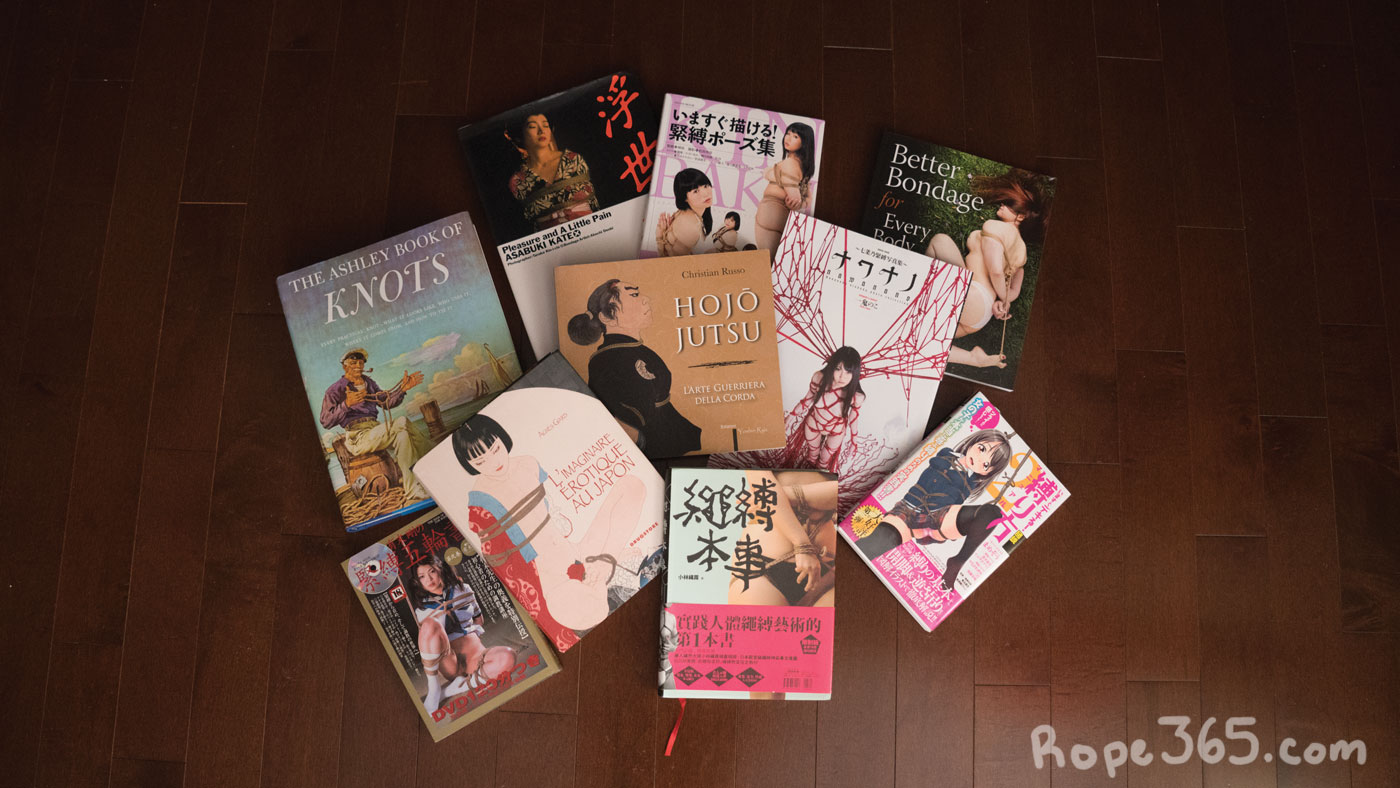
The practice of rope bondage has changed drastically over time. Different inspirations, styles, and approaches have set the table for the wide variety in today’s creativity. Rope has a rich history that we can dig into and learn from. Knowing where we come from allows for a deeper understanding of the craft.
The past is not all romance. Violence, unsafe practices, and lack of consent are just some of the darker aspects of bondage history. We can learn from both the greatest innovations and the mistakes of the past. Because of bondage’s unconventional nature, much of the historical knowledge is hidden and may disappear, and more and more people are trying to assemble information and records from our history to preserve what we have. It’s an interesting subject to revisit over and over as new information keeps popping up.
This topic is vast, and it can be overwhelming because the information is numerous and often contradictory. This week is structured to help you explore the origins of rope through different mediums and purposes.
The goal of this week is to gain a better understanding of the history of rope bondage and to discover new sources of inspiration in the rope from the past.
Activities
Day 281: Farmers and Sailors
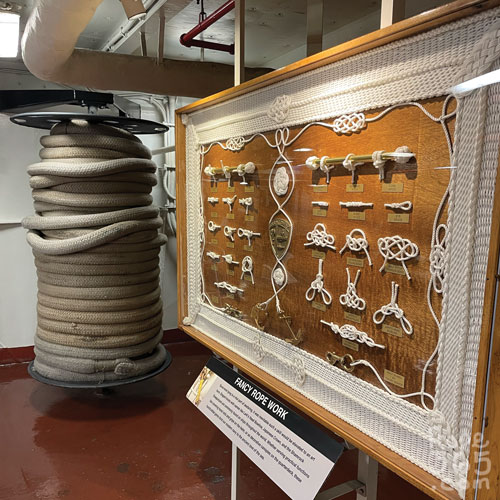
Rope was originally invented for practical use. Many of our ancestors used it in their daily lives and developed a variety of techniques for hunting, transport, building, etc. Today, various careers, such as arborists and stage riggers, still use rope in their work.
Look into common uses of rope and explore ideas to integrate into your rope play. Make a lasso out of a rope; try different methods used to set up a sail or anchor a boat, etc. How is rope used to transport plants or animals on a farm? What common usage of rope inspired some of the tools you already have? How could you apply other professional rope-use to your practice?
- Cleat hitch lasso to anchor boat
- Quick release knot to attach animals by Ryan Rose
- Lasso half hitch by its_tumbleweed
- Video by kencarterx and old_bull_ (Lasso)
- The Ashley Book Of Knots by Clifford W. Ashley on Internet Archive
- Perry_trees on Instagram (arborist)
- Firefighter shows how to carry a casualty using just a piece of rope by firefighter__forlife
Day 282: Religion and Spirituality
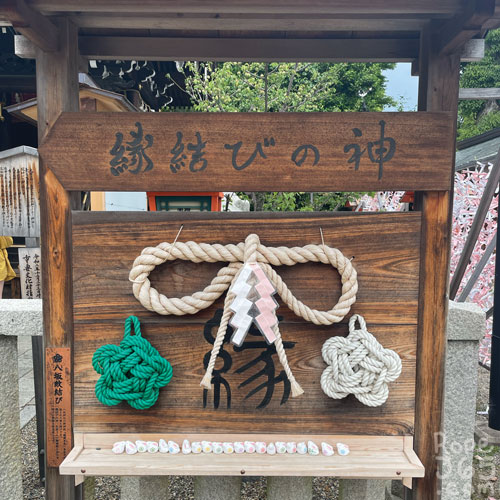
Some ropes and knots have specific meanings in certain cultures. It is common to find rope of a specific colour tied in a specific knot in Shinto temples. Good luck charms sometimes include knots specific to the type of wish. This can be an interesting topic to dig into, both to understand the deeper meaning of rope in certain cultures, and to give additional purpose to the rope we use.
Day 283: Paintings and Drawings
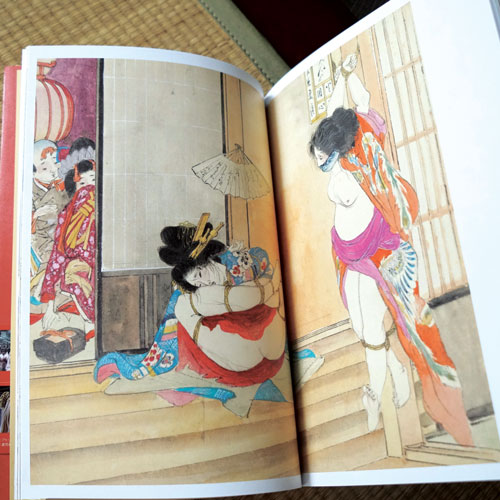
Representation of people tied up dates back to the early days of painting. Egyptian pyramids had depictions of enslaved people on their walls. Many Ukiyo-e 浮世絵 woodblock paintings from Japan’s Edo period (1600-1868) feature people tied up. We can find representations of criminals using rope to attack their victim, or being tied up by the military. In particular, Tsukioka Yoshitoshi 月岡芳年 (1839 – 1892) was renowned for his gory paintings, sometimes featuring rope, including the famous The Lonely House on Adachi Moor, which depicts a pregnant woman suspended upside down by rope.
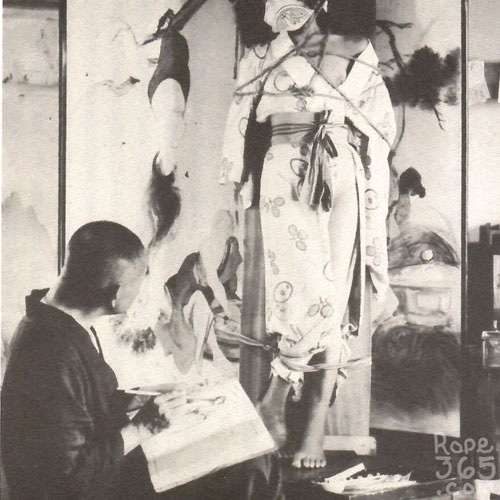
These likely inspired others, particularly Itō Seiu 伊藤晴雨 (1882-1961), a painter recognized as one of the pioneers of Kinbaku. He created a large body of erotic artwork, including drawings, paintings and photography showing bound women being tortured and other forms of punishment. Japanese painters Ozuma Kaname 小妻要 and Go Mishima 三島剛 are also famous for their illustrations of people in bondage.
Comic books have also included a lot of representation of rope bondage. In the 1930s, European fetish illustrator Carlõ published several books with illustrations of domination and submission. He was an inspiration to other illustrators, such as the American John Willie, famous for his character Sweet Gwendoline, who always seems to get into trouble and ends up tied up. Many other comic book artists explored bondage, including Tom of Finland (homoerotic), Eric Stanton (dominant wives), and Gene Bilbrew (the first black career fetish artist).
- Rope Artists References: Itō Seiu by Rope365
- Seiu Itō’s Blame Arts – Book Review by Rope365
- Kaname Ozuma on Instagram
- Beauty and Violence: Japanese Prints by Yoshitoshi, 1839-1892 on Internet Archive
- John Willie on Wikipedia
- Tom of Finland on Internet Archive – 25 – The Art of Pleasure
- The Dominant Wives & Other Stories by Eric Stanton on Internet Archive
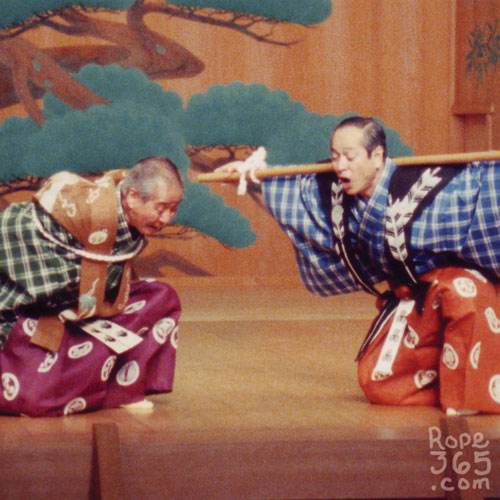
Day 284: Theatre and Performances
The fantasy of being tied up has inspired many stories and stage acts. Theatre, in particular, is an important part of the history of rope bondage, as it was a key inspiration for the early shibari pioneers. Tying on the stage is different from tying real prisoners; it becomes acceptable for the tie to be escapable, and it doesn’t need to cause pain. The aesthetic, safety and emotions created by the tie are much more important.
Rope performance has now become its own art form. Starting with Osada Eikichi in the 1960s onward, the medium has continued to evolve to this day. Looking at different stage performances, vanilla and kinky alike, can inspire your practice. What styles of interaction, tying, and communication can you borrow from stage performances?
- Famous Plays: Kyogen Bo Shibari (Tied to a Stick)
- Kyogen Bo Shibari Clip 1 Clip 2
- Magic Clip 1 Clip 2
- Osada Eikichi articles by Osada Steve 1 2 3
- The Eikichi Osada Legacy: the Advent of Performance Shibari
- Eikichi Osada on Nawapedia
- Rope performance playlist on Rope365 YouTube
Day 285: Photography and Prints
With the advent of early photography and innovations in printing technologies, the documentation of erotic bondage began to change. Some of the earliest known erotic rope photographs are at the Musée d’Orsay in Paris from artist Charles-François Jeandel and were taken between 1890-1900. In the 1930s, the Ostra/Biederer Studio in Paris, owned by two Czech brothers, was publishing erotic photo sets and stag reels, many of which included rope bondage and other BDSM practices.
Rope magazines gained some popularity and were travelling, which allowed artists from around the world to inspire each other. Some notable ones are Kitan Club 奇譚クラブ (1947-1975) in Japan and Bizarre Magazine in the USA, which showcased a wide diversity of tie styles.
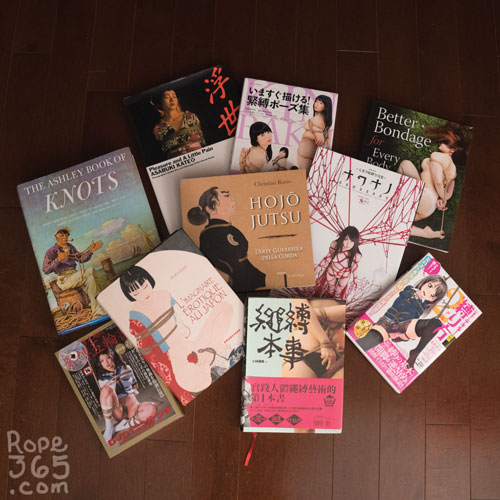
The first published kinbaku book was Utsukushiki Imashime 美しき縛しめ (Tying in a Beautiful Way to Punish) in Showa 28 (1953) by Minomura Kou 美濃村晃 (author), and was shortly followed by a volume 2 with Tsujimura Takashi 辻村隆 as author in the same year. Later on, tutorial books began with SM耽美文学別巻 SMプレイ (SM Play – You can play SM) by Urado Hiroshi 浦戸宏 in 1972.
Today, more books are being published around the world in a huge diversity. Some older, harder-to-find prints are being digitized so more people can discover them. What kind of books catch your interest? Pick a random page and analyze the tie. What was the context of the picture (ex: photoshoot, play, performance)? What was the purpose of the tie? Where did it start? What building blocks are used? How do you need to adapt it to the person tied up? Do you need to make safety adjustments to fit your risk profile?
- Album de photographies de Charles-François Jeandel by Musée d’Orsay
- Kitan Club Photography by Mr. Bunjoushashin
- Nostalgic Kitan Club by くろねこ記
- Kitan Club Early Shibari Photo by Esinem
- Kitan Club, sample photos from 1953 and 1954
- The complete reprint of John Willie’s Bizarre on Internet Archive
- Betty Page in Bondage on Internet Archive – Vol 1 – Vol 2 – Vol 3 – Vol 5
- Book References by Rope365
- Kinbaku Books by Bergborg
Day 286: Movies and Videos
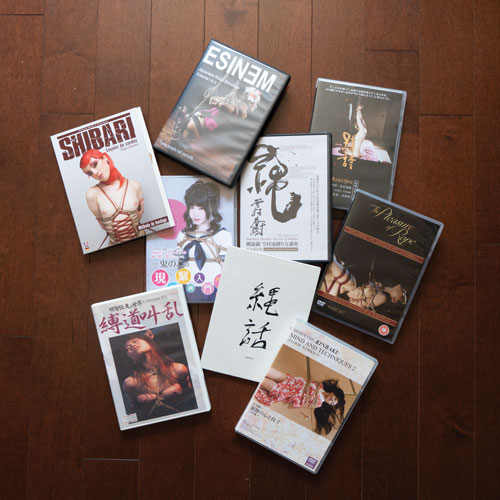
Being captured and tied up has become an important trope in cinema. With this new media quickly bringing representation of bondage in vanilla movies and niche pornography.
Later on, as videos could also be shared online, more content was created, and rope bondage started making regular appearances in other mainstream media such as music videos. It is also easier than ever to find tutorials and videos of people tying on social media.
Videos are great tools for exploring different styles and approaches. Movement is an important aspect of the practice, and seeing the action brings it to a new level. What mainstream movie references inspire you in your practice? Have a look at videos or people tying, tutorials and more; what would you like to learn more about?
Day 287: Genealogy and Evolution
At what point in history did rope restraint become an erotic art? What inspired the first practitioners? And who inspires the artists of today?
Pick a person or a pattern, climb the genealogical tree. Who did you learn it from, who did they learn it from, and how did it change over time? What was the original inspiration? Was there a particular meaning to the tie?
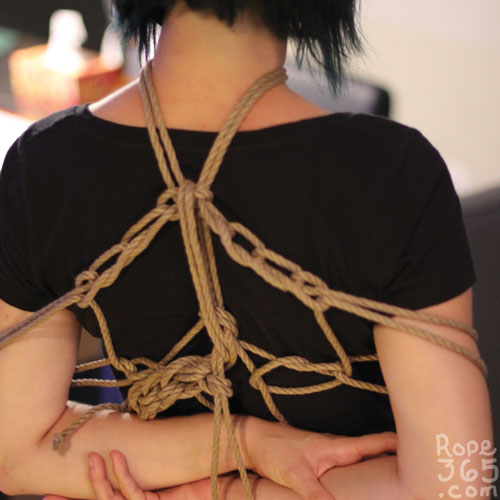
Review: Prisoner Ties
The potential for restriction and torture of rope was used by the forces of order and the criminals alike. Look at the different techniques used to capture and torture. Take the time to reflect on the ethics of tying and its violent history. For example, the use of rope in the slave trade or the torture of Edo to interrogate prisoners used by the Japanese military. You can expand beyond the topic of prisoners’ ties and look into different torture and interrogation method that relies on restrictions.
Video References
We compiled a YouTube playlist with various videos on this topic; let us know if you find any others we should add to it. Note that video references may display risky or unstable techniques; viewer discretion is advised.
Gallery
Inspirations and Resources
- A Brief History of Rope Bondage by ropestudy
- The History & Myths of Japanese Bondage by Midori
- Kinbakunomicon by Faviola_Llervu
- Nawapedia
- History on Kinbaku Today by Zetsu
- History and diversification of Kinbaku by Kanna & Kagura
- Outline Chronology of Japanese LGBT History & Japanese SM History by Kanna & Kagura
- “M-jo” in Kinbaku: A Personal Perspective 「M女」の変遷 by Kagura
- Edo Not Dead…. by NuitdeTokyo
- シンポジウム「緊縛ニューウェーブ×アジア人文学」Symposium Kinbaku New Wave and Asian Humanities (Kinoko at Kyoto university)
- Random boring and worthless thoughts on “seme”, the word by Nuitdetokyo
- Eat the rich, and other musings about kinbaku history by Nuitdetokyo
- History of kink by tripp.terrier
Or return to Winter for more options.
Credit: Books P: Ebi McKnotty